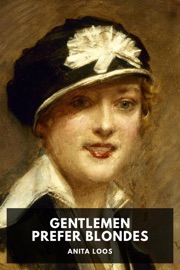
The book that inspired the iconic Marilyn Monroe movie. Follow the hilarious adventures of Lorelei Lee of Little Rock, Arkansas, and her friend Dorothy as they barrel their way across Europe leaving awe-struck gentlemen in their wake. Lorelei may be a small-town girl at heart, but even she knows that gentlemen prefer blondes, and that while a gentleman kissing your hand may make you feel very, very good, a diamond bracelet lasts forever.
When it was published in 1925, Gentlemen Prefer Blondes immediately sold out on the day it reached the bookshops. It went on to become a best seller in over a dozen languages. It was made into a popular play the following year and became the basis for two motion pictures, including the classic Howard Hawks directed version staring Marilyn Monroe as Lorelei and Jane Russell as Dorothy.
Anita Loos later wrote that she came up with the idea for the story while travelling cross country via train with a group of Hollywood personalities including heartthrob idol Douglas Fairbanks, Sr. (Loos was a scriptwriter herself). Among the passengers was a young soon-to-be-starlet, a blonde, who all of the men fawned over, while Loos, a brunette, was left to tote her own bags. While watching the spectacle, she remembered that even her good friend and idol H. L. Menckenâwho Loos described as âone of the keenest minds of our eraââhad once fallen head-over-heels for a young woman Loos called âthe dumbest blonde of all.â And so, Lorelei Lee was born, and she has become the archetypal vamp keen on material values in love affairs.
Praise for Gentlemen Prefer Blondes
âA gorgeously smart and intelligent piece of workâ
âThe New York Times
âThe great American novelâ
âEdith Wharton
âI wish I had thought of Dorothy firstâ
âWilliam Faulkner in a letter to Loos
Listed on âThe 100 Greatest Novels Written in Englishâ by The Guardian in 2015
A Note about the Text
This edition of Gentlemen Prefer Blondes published by Scruffy City Press, LLC, meets WCAG 2.0 AA standards for accessibility and has been professionally edited and compared to the original 1925 publication to ensure accuracy.
The book that inspired the iconic Marilyn Monroe movie. Follow the hilarious adventures of Lorelei Lee of Little Rock, Arkansas, and her friend Dorothy as they barrel their way across Europe leaving awe-struck gentlemen in their wake. Lorelei may be a small-town girl at heart, but even she knows that gentlemen prefer blondes, and that while a gentleman kissing your hand may make you feel very, very good, a diamond bracelet lasts forever.
When it was published in 1925, Gentlemen Prefer Blondes immediately sold out on the day it reached the bookshops. It went on to become a best seller in over a dozen languages. It was made into a popular play the following year and became the basis for two motion pictures, including the classic Howard Hawks directed version staring Marilyn Monroe as Lorelei and Jane Russell as Dorothy.
Anita Loos later wrote that she came up with the idea for the story while travelling cross country via train with a group of Hollywood personalities including heartthrob idol Douglas Fairbanks, Sr. (Loos was a scriptwriter herself). Among the passengers was a young soon-to-be-starlet, a blonde, who all of the men fawned over, while Loos, a brunette, was left to tote her own bags. While watching the spectacle, she remembered that even her good friend and idol H. L. Menckenâwho Loos described as âone of the keenest minds of our eraââhad once fallen head-over-heels for a young woman Loos called âthe dumbest blonde of all.â And so, Lorelei Lee was born, and she has become the archetypal vamp keen on material values in love affairs.
Praise for Gentlemen Prefer Blondes
âA gorgeously smart and intelligent piece of workâ
âThe New York Times
âThe great American novelâ
âEdith Wharton
âI wish I had thought of Dorothy firstâ
âWilliam Faulkner in a letter to Loos
Listed on âThe 100 Greatest Novels Written in Englishâ by The Guardian in 2015
A Note about the Text
This edition of Gentlemen Prefer Blondes published by Scruffy City Press, LLC, meets WCAG 2.0 AA standards for accessibility and has been professionally edited and compared to the original 1925 publication to ensure accuracy.