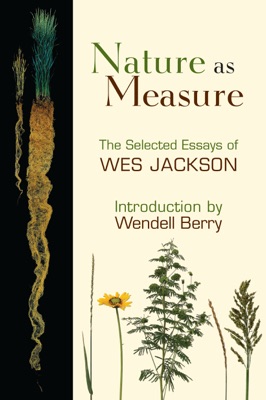
An essential and timely collection of wise and compelling essays from one of the longtime leaders of the sustainable agriculture movement in America.
Wes Jackson, âa wellâknown and admired advocate for sustainability especially as it relates to agriculture, has the rare ability to transform his convictions into captivating prose . . . Jacksonâs thoughts are still as significant and profound as they were nearly 20 years agoâ (Publishers Weekly) and can teach us many things about the land, soil, and conservation, but what most resonates is this: The ecosphere is selfâregulating, and as often as we attempt to understand it, we are not its builders, and our manuals will often be faulty. The only responsible way to learn the nuances of the land is to study the soil and vegetation in their natural state and pass this knowledge on to future generations.
â[A] small book rich in ideasâ (The New York Times Book Review), Nature as Measure collects Jacksonâs essays from Altars of Unhewn Stone and Becoming Native to This Place, presenting ideas of land conservation and education that are written from the point of view of a man who has practiced what heâs preached and proven that it is possible to partially restore much of the land that weâve ravaged. Wes Jackson lays the foundation for a new farming economy, grounded in natureâs principles and located in dying small towns and rural communities. Exploding the tenets of industrial agriculture, Jackson seeks to integrate food production with nature in a way that sustains both. His longtime friend Wendell Berry provides an informative, contextual Introduction.
âFor those concerned about what will be left and how many billion will be starving in twenty years, this is a must read.â âRegister of the Kentucky Historical Society
âA good introduction to a thinker whose ideas on agriculture are radical both in their technical approach to food production as well as in terms of the economic, social, and cultural context within which it is practiced.â âReview of Radical Political Economics
An essential and timely collection of wise and compelling essays from one of the longtime leaders of the sustainable agriculture movement in America.
Wes Jackson, âa wellâknown and admired advocate for sustainability especially as it relates to agriculture, has the rare ability to transform his convictions into captivating prose . . . Jacksonâs thoughts are still as significant and profound as they were nearly 20 years agoâ (Publishers Weekly) and can teach us many things about the land, soil, and conservation, but what most resonates is this: The ecosphere is selfâregulating, and as often as we attempt to understand it, we are not its builders, and our manuals will often be faulty. The only responsible way to learn the nuances of the land is to study the soil and vegetation in their natural state and pass this knowledge on to future generations.
â[A] small book rich in ideasâ (The New York Times Book Review), Nature as Measure collects Jacksonâs essays from Altars of Unhewn Stone and Becoming Native to This Place, presenting ideas of land conservation and education that are written from the point of view of a man who has practiced what heâs preached and proven that it is possible to partially restore much of the land that weâve ravaged. Wes Jackson lays the foundation for a new farming economy, grounded in natureâs principles and located in dying small towns and rural communities. Exploding the tenets of industrial agriculture, Jackson seeks to integrate food production with nature in a way that sustains both. His longtime friend Wendell Berry provides an informative, contextual Introduction.
âFor those concerned about what will be left and how many billion will be starving in twenty years, this is a must read.â âRegister of the Kentucky Historical Society
âA good introduction to a thinker whose ideas on agriculture are radical both in their technical approach to food production as well as in terms of the economic, social, and cultural context within which it is practiced.â âReview of Radical Political Economics